)
How AI Is Accelerating Innovation Across the Food System
Artificial intelligence is rapidly reshaping the global food system, a strategic engine that can reduce waste and accelerate decision-making. Far beyond chatbots, AI now informs ingredient design, regulatory compliance, R&D workflows, supply chain resilience and personal health. As adoption accelerates, food leaders are grappling with questions: What can AI genuinely deliver? Where are its limitations? And how can food leaders apply it responsibly?
These questions are rising to the forefront ahead of Future Food-Tech San Francisco, where AI is one of the core pillars shaping this year’s program. The summit will gather experts exploring grounded, practical applications of AI that can support more resilient, efficient and sustainable food systems.
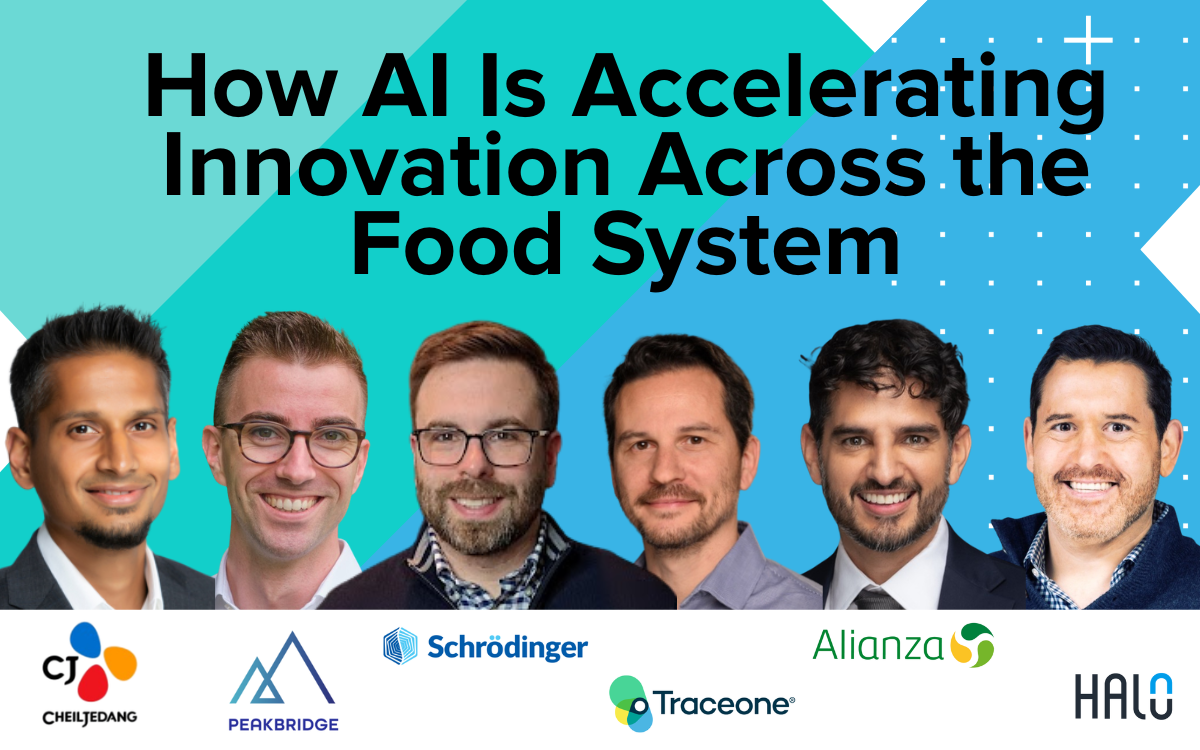
To understand the current state of AI in food-tech, we asked six leaders driving the transformation to share where AI is making the biggest impact, which fears are unfounded and what capabilities they hope to see emerge over the next decade. A common thread emerged: the most powerful AI is not replacing experts. It is amplifying them.
AI as the new orchestrator of nutrition, health and food systems
For Thomas van den Boezem, Partner at PeakBridge, one of the biggest misunderstandings is the assumption that AI is merely a tracking tool. In reality, it is becoming an integrator - connecting data streams that were previously impossible to analyze together at scale.
“AI is not just for tracking, it is an orchestrator. Think about nutrition and health: we can now measure everything including glucose, ketones, hormones, sleep and DNA,” he says. “But that data alone does not mean much. The breakthrough is through AI platforms that can integrate all of it into electronic health records, pharmacy systems and physician data.”
The same principle applies to food and beverage companies, he notes. AI must support existing systems, not disrupt them.
“Food and beverage companies operate in heavily regulated environments with fixed processes. AI tools have to fit into existing workflows and show measurable ROI,” he adds.
Across the industry, this theme is echoed: AI works best when it becomes part of the fabric of daily operations.
Inside the AI-driven innovation cycle
At CJ CheilJedang Foods, AI is already reshaping the end-to-end innovation journey. Auroni Majumdar, VP of Global Open Innovation R&D, emphasizes that AI is interwoven across insights, prototyping and manufacturing - not as a replacement but as a productivity multiplier.
“We use AI across the full end to end innovation cycle, from insights generation and concept development to product development and operations,” he explains.
On the consumer insights side, CJ uses AI-driven intelligence platforms to interpret global flavor trends, category disruptions and micro level textural preferences. AI also supports technical R&D:
“We leverage AI for technology landscaping, strategy development and iterative hypothesis generation, which is then validated in the lab. Those results feed back into the system for ongoing optimization.”
The biggest takeaway? Efficiency. Cycles are faster, bottlenecks disappear and experimentation becomes more targeted. But success depends on expertise.
“The key constraint is the need for internal super users who understand both the tools and the context of large scale food innovation.”
Without that dual fluency, he warns, models risk hallucinations or misuse. AI is powerful, but only in the right hands.
Designing molecules with AI: A new era of food R&D
Many food companies still rely on trial and error. Schrödinger brings a radically different model to the industry: physics-informed AI that predicts ingredient interactions at the molecular level. Product Manager Jeff Sanders argues that this shift is long overdue.
“Roughly 20,000 new products launch every year, yet the failure rate exceeds 80 percent. This massive waste stems from the industry’s reliance on blind trial and error,” he explains. “We do not replace the lab. We make it smarter.”
Schrödinger’s system predicts instability and incompatibility before formulation reaches the bench, saving resources and reducing failure rates.
Sanders stresses that not all AI is equal. Trust is essential.
“Many tools are black boxes that generate statistical guesses without explaining the underlying mechanism. Schrödinger is different. We offer a glass box view that combines the speed of AI with the rigor of physics.”
He points to emerging successes like NotCo to prove the science works. However, achieving widespread adoption requires cultural change.
“Capturing the full value of next-generation toolsets requires people to do things in new ways. Transitioning from trial and error to hypothesis-driven design demands a shift in mindset.”
Looking ahead, Sanders imagines a future where food is intentionally designed at the molecular level, not discovered by accident.
AI for compliance, quality and risk reduction
While much of AI’s publicity centers on R&D, regulatory compliance remains one of the industry’s most complex pain points. Federico Fontanella, Head of Strategic Innovation and Product Partnerships at Trace One, believes this is where AI’s real power lies.
“AI is most powerful when it works with trusted data and domain expertise. In food, the value is not flashy automation but continuous control,” he says.
Trace One Copilot is embedded directly inside PLM and compliance systems, supporting R&D, packaging, quality and regulatory teams.
“A common fear is that AI replaces human expertise. In practice, the best systems keep humans in control and use AI to surface insights faster and more reliably.”
Fontanella identifies the main hurdles as data quality, governance and integration. Without clean product data, no AI system can deliver safe results.
He hopes the next decade brings proactive AI systems that monitor regulatory changes in real time, simulate formulas and design compliance into products from the start.
AI as a force multiplier for food science
For Camilo Castro, AI Corporate Director at Alianza, the conversation starts and ends with lipids. Lipidia, the company’s AI platform, is purpose-built for lipid science and already delivers measurable value.
“When we combine our clients’ needs with Lipidia, weeks of trial and error become days or even hours of focused iteration,” he says. “The value is tangible: faster time to market, fewer lab runs, reduced saturated fat, lower cost and measurable CO2 savings.”
But Castro emphasizes that AI enhances – not substitutes - expertise.
“AI does not replace experts. It amplifies them. Our lipid scientists remain at the center and are the owners and developers of Lipidia.”
With strong guardrails like private deployments and audit trails, the team is focusing on the next evolution.
“Our vision is a comprehensive AI framework that integrates physics-informed formulation, closed-loop plant connectivity and regulatory-by-design protocols.”
Ultimately, Castro describes a future where AI transforms inconsistent raw materials into predictable nutrition, boosting resilience and sustainability.
Connecting the global innovation ecosystem
Halo takes a different approach by focusing on matching. Founder and CEO Kevin Leland explains that food innovation is increasingly multidisciplinary, yet discovery often remains slow and fragmented.
“AI’s highest leverage in food is speed to clarity. It reduces the time between a question and a set of options worth testing,” he says.
Halo enables researchers, suppliers and start-ups to showcase capabilities while AI matches needs to solutions. But trust is essential.
“The biggest hurdles are adoption and trust. Teams need transparency in why something is recommended and confidence that results are reproducible.”
Leland’s vision is for AI that companies can rely on in high-stakes settings.
“I want AI that is measurably trustworthy. That means clear uncertainty, traceable reasoning and learning from real-world feedback.”
He also hopes to see stronger system optimization across forecasting, handling and logistics, as well as privacy-preserving collaboration so companies can learn from shared patterns without compromising IP.
What’s next: Precision, trust and proactive design
Across these six expert perspectives, several themes emerge:
- AI will not replace experts - it will transform their work.
- Data quality determines AI performance.
- Transparent AI will become essential in regulated environments.
- The future is proactive rather than reactive.
- The next decade will be defined by intentional design, not accidental discovery.
Conclusion: AI is becoming the infrastructure of food innovation
AI in food tech is no longer experimental. It is embedded, operational and accelerating some of the industry’s most complex challenges - from formulation to compliance to partnership discovery. Across every insight shared, one message stands out: AI delivers its greatest value when it is paired with strong expertise, reliable data and responsible governance.
With scientists, regulators and innovators guiding the process, AI becomes the infrastructure that supports faster innovation, greater resilience and more sustainable food systems.
These themes will come into sharp focus at Future Food-Tech San Francisco on March 19-20, with a dedicated AI Innovation Lab workshop on day two of the summit. Experts will lead exploration of the tools, use cases and practical frameworks shaping the next chapter of AI-driven food innovation.
Secure your ticket now to join the action.
)
)
)
)
)
)
)
)
)