)
MAHA: Driving a Cultural Shift in Food and Nutrition
The Make America Healthy Again (MAHA) initiative represents a cultural shift. Designed to address rising rates of obesity, metabolic disorders, and diet-related chronic diseases, MAHA signals a new era for the U.S. food system. Its priorities - natural ingredients, transparency, and improved nutrition - are reshaping how companies innovate, market, and build trust for businesses, MAHA is not just a compliance challenger; it is a strategic opportunity to lead in health and sustainability.
The stakes are high. Poor diet is linked to over $1 trillion in annual U.S. healthcare costs, and consumer trust in food brands has declined amid concerns about ultra-processed foods. MAHA responds by encouraging reformulation, cleaner labels, and nutrient-dense products. But as industry leaders emphasize, success requires more than meeting minimum standards - it demands a proactive, science-driven approach.
Why MAHA Matters
MAHA reflects a global trend toward health-centric regulation. Similar frameworks in Europe, such as nitrite restrictions, and initiatives in Asia targeting sugar reduction, show that the food industry is entering an era where health outcomes drive innovation. For U.S. companies, MAHA means rethinking product portfolios, supply chains, and marketing strategies.
Consumers now expect more than “less sugar” or “no artificial colors.” They want proof of positive health impact, better satiety, improved metabolic markers, and gut-friendly formulations. This demand is amplified by the rise of GLP-1 medications, which are changing eating behaviors and creating for a market for smaller, nutrient-dense portions. MAHA aligns with these trends, transforming compliance from a cost burden into a growth lever for innovation and competitive advantage.
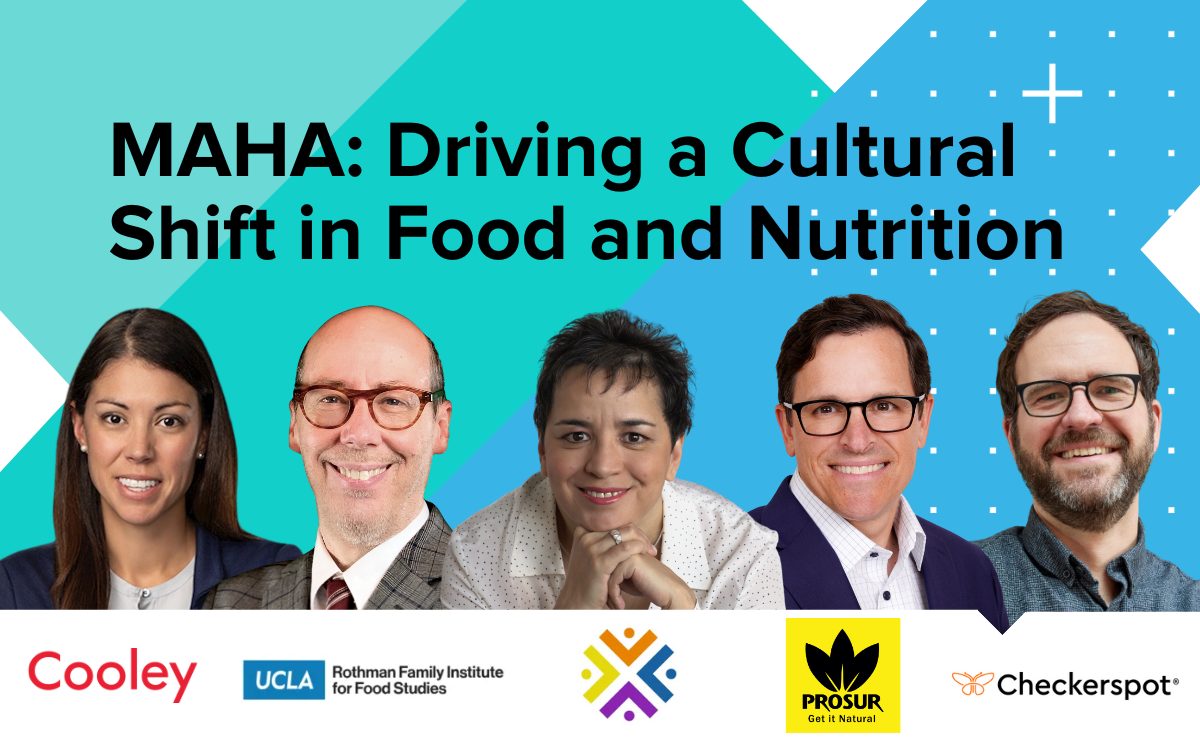
Ahead of Future Food Tech San Francisco, we caught up with experts at Cooley, Rothman Family Institute for Food Science - UCLA, Nutrition Sustainability Strategies, Prosur and Checkerspot to see how they're responding to this transformation.
The Regulatory Shift: From “Remove the Bad” to “Prove the Good”
The food industry in undergoing a fundamental shift. Companies are no longer judged solely on what they eliminate from products – increasingly, they must demonstrate measurable health benefits. Maha Tahiri, CEO of Nutrition Sustainability Strategies, explains:
“The industry has been moving fast, largely because the regulatory landscape is shifting from ‘remove the bad’ to ‘prove the good.’ That shift is reshaping everything.”
This change requires brands to go beyond compliance and proactively design healthier, more transparent products.
“Companies shouldn’t be waiting for mandates; they’re building future-proof recipes. They need to continue reducing refined carbs, simplifying ingredient lists, eliminating questionable additives, and leaning into whole-food-based structures long before regulation demands it,” says Tahiri
Children’s Nutrition: A Key Pressure Point:
Stricter sugar thresholds, nutrient-density requirements, and scrutiny of additives in kids’ foods are pushing companies to reformulate with bioactives, fermented ingredients, and higher-quality proteins that better support development, satiety, and gut health.
“It’s no longer about staying compliant. The industry needs to regain consumer trust before regulators get there.” emphasises Tahiri.
Innovation as a Compliance Strategy
Brian Metzger, Vice President North America at Prosur, highlights how innovation and regulation go hand in hand:
“We track emerging frameworks closely, whether it is the new nitrite regulations in the EU or MAHA in the U.S. Adaptation begins long before regulations change. Innovation and regulation move side by side because we create solutions that reflect what consumers want: naturalness, transparency and simplicity, while already aligning with policy trends."
Prosur’s Smarter Sweeteners platform demonstrates this approach – helping brands reduce glycemic impact while adding functional benefits like polyphenols and probiotics.
“Clear label, safety and great taste can work together. Real innovation begins with a mindset shift. Companies need to view MAHA not as a constraint but as an opportunity to create healthier and more transparent products that consumers actively seek,” says Metzger.
He also points to technology as an enabler:
“We support brands with upgraded fermentation methods, circular models like farm-to-fork, upcycled raw materials, and AI tools that accelerate development.”
Precision Design: The Future of Ingredients
John Krzywicki, CEO of Checkerspot, sees MAHA as a catalyst for precision innovation:
“One of the most exciting innovations emerging in this new regulatory environment is the ability to design ingredients with unprecedented precision.”
Checkerspot’s platform produces tailored lipids for diverse applications:
- Molecular replicas of fats in maternal milk to improve infant formula nutrition
- Structured fats to stabilize supply chains
- High-smoke-point cooking oils that are healthier for people and the planet
“Regulatory environments may shift at the margins, but the goal remains the same: protecting consumers and ensuring a safe, trustworthy food system remains the goal.” Krzywicki notes.
Consumer Trust: The Ultimate KPI
Jack Bobo, Executive Director at UCLA’s Rothman Family Institute for Food Studies, emphasizes that compliance alone isn’t enough:
“Balancing regulation and innovation isn’t a zero-sum game. It’s a trust equation. Regulation sets the floor for safety, not the ceiling for ambition.”
Transparency and clear communication are now as critical as scientific innovation
“The real opportunity lies in designing products and narratives that meet regulatory standards and inspire consumers to see innovation as part of a healthier, more sustainable future,” says Bobo
Emerging Trends in MAHA
Tahiri identifies several innovation waves shaping the market:
- Re-engineering ultra-processed foods using fermentation and sprouting to replace synthetic additives.
- GLP-1-informed development, creating nutrient-dense, gut-friendly formulations for metabolic health.
- Precision fermentation and bioactive compounds, offering cleaner alternatives to synthetic additives.
- Accessible personalization, leveraging AI for scalable nutrition solutions.
“We’re approximately 3–5 years away from seeing scalable personalized nutrition in specific categories, likely starting with supplements and functional beverages,” she predicts.
Sustainability is increasingly tied to health:
“New regulations link environmental impact to health positioning. Companies are moving upstream to regenerative sourcing and nutrient-rich crops.”
Legal and Regulatory Risks
Laura Akowuah, Special Counsel at Cooley, cautions: “FDA has yet to formally define ‘natural.’ As a result, class action lawsuits challenging ‘natural’ claims are likely to grow.”
She advises:
“Forward-thinking companies can tap into high-growth segments that emphasize transparency and ingredient integrity while mitigating the risk of litigation or an action from a regulator.”
MAHA introduces complexities for companies product development due to divergent expectations at state and federal levels. As brands navigate ingredient innovation, they must take cautious steps to ensure compliance across all layers of regulation within their food and beverage portfolios. While this presents a significant challenge for corporations, it also creates an opportunity to integrate natural ingredient solutions into products.
Regulation as a Growth Engine
Tahiri concludes with a call to action:
“The companies leading the way are not choosing between regulation and innovation. They’re using regulation to power innovation that genuinely improves population health.”
Krzywicki echoes this sentiment:
“When you innovate with alignment in mind, you don’t have to choose between meeting regulatory requirements and making a meaningful impact. You accomplish both.”
MAHA represents a turning point for the U.S. food system - challenging companies to go beyond compliance and create healthier, more transparent and sustainable products. For those willing to innovate boldly, MAHA is not a hurdle; it is a launchpad for growth, trust, and leadership in the next decade of food.
Join the Conversation
The discussion continues at Future Food-Tech San Francisco, March 19-20 where industry leaders will collaborate to build healthier, more resilient food systems.
Secure super early bird pass today and save $700.
)
)
)
)
)
)
)
)
)